
Impact Evaluation
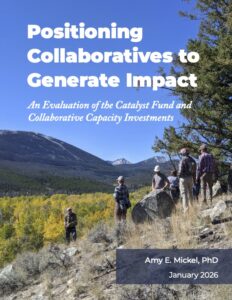 In early 2025, we contracted an independent evaluation of the Catalyst Fund, to better understand the unique value and contributions of this program, and to explore what if any insights emerge more generally about the relationship between collaborative capacity investments and on the ground landscape outcomes.
Behind the Catalyst Fund is a simple idea: That targeted capacity investments in place-based landscape collaboratives can be catalytic, positioning those collaboratives to more effectively advance their landscape visions and goals over time.
This idea steams from a belief that such collaboratives—by bringing folks that care about a landscape together across issues, interests, and jurisdictions and by creating space for them to build trust, shared strategy, and an understanding of how to work together—are uniquely positioned to deliver outcomes that build better futures for our lands and waters, and the communities that depend on these.
The evaluation validates the program’s central idea: Evaluation findings “affirm the premise of the Catalyst Fund,” highlighting that investing in how partners work together can enable greater conservation and stewardship outcomes. Specifically, the evaluation demonstrates that:
- Catalyst Fund investments worked as intended, strengthening the collaborative process of funded collaboratives, and;
- Strengthened collaboratives, over the long term, are delivering better on-the-ground conservation and stewardship outcomes.
As the interwoven biodiversity, climate, and environmental injustice crises drive our sense of urgency to accelerate conservation and stewardship progress, the Catalyst Fund aims to help grantees do more—not more on a specific, singular project, but more over the long term.
Evaluation findings underscore how, by investing in collaborative capacity, the Catalyst Fund helps grantees become the type of durable, adaptive, and effective collaboratives that we need if we are to address today’s complex and systems-level challenges. What is increasingly clear is that collaborative capacity investments are, in effect, long-term, highly strategic, and compounding investments in accelerating the delivery of on-the-ground conservation, stewardship, and restoration outcomes.
Read the Executive Summary Explore the full Report
By looking at how Catalyst Fund support enabled funded collaboratives to generate a set of interconnected benefits, and at how those benefits build upon one another in a process that delivers conservation and stewardship impact, the evaluation also surfaces key insights for the field of practice as a whole:
Landscape collaboratives are proven vehicles for scaling up, accelerating, and sustaining conservation and stewardship impact. Because they weave together expertise, perspective, and capacity across partners, collaboratives are uniquely positioned to deliver impactful conservation outcomes—they are able to imagine, develop, and deliver projects that wouldn’t otherwise happen, accelerating and scaling outcomes that can address the complexity of biodiversity loss, climate change, and environmental injustice.
A landscape collaborative’s performance (i.e., what it achieves) is directly connected to its function (i.e., how it operates)—and you can’t optimize the former without investing in the latter. Accelerated conservation & stewardship impact isn’t guaranteed by collaboration nor does it magically emerge out collaboratives—rather, it emerges through intentionally cultivating the quality of the process through which partners are able to work effectively together towards shared purpose.
Collaborative capacity is a critical driver of conservation impact. Evaluation findings captures how collaboratives, when resourced effectively, advance an interconnected set of benefits—and illustrates how these benefits build upon one another in a process that delivers conservation and stewardship impact. Collaborative capacity—those elements that allow a group of partners to function together effectively towards shared purpose—is the critical driver of this impact process.
Fostering practitioner capacity is vitally important. Dedicated coordination support often is critical “glue” for collaboratives, and a majority of Catalyst Fund grants included funding to cover the coordination role. Coordinating collaboration requires skills and approaches that differ from what many of us have developed in our careers, and time and again we see practitioners sensing an essential skillset exists just beyond their grasp. It is insufficient to simply staff the coordinator role—equally important is equipping the individual with the skills, experience, and practical knowledges to be effective and successful. The manner in which the Catalyst Fund invests financial resources (via grant awards) into strengthening the collaborative process of a landscape collaborative AND builds (via peer learning) the individual capacity of key leadership within the collaborative is mutually reinforcing in a way that better positions the collaborative to achieve its on-the-ground conservation and stewardship goals.
About the Catalyst Fund: The Catalyst Fund, a national competitive regranting program administered by the Network for Landscape Conservation, delivers collaborative capacity investments to place-based landscape collaboratives. The Network is grateful to the Doris Duke Foundation and the William & Flora Hewlett Foundation for supporting the Catalyst Fund through its first seven years.
Across its first seven annual grant cycles (2019-2025), the Catalyst Fund distributed more than $2.5 million in collaborative capacity grant awards to 103 landscape collaboratives—including 36 that are Indigenous-led. During this period, the Catalyst Fund received more than 850 proposals, totaling more than $20 million in requested funding.
The impact that the program had at the individual landscape level is noteworthy, but equally so is its impact at the field-wide level: By explicitly shining a light on collaborative capacity investments for landscape collaboratives, the Catalyst Fund has contributed to elevating an understanding of the potential of collaborative landscape conservation and stewardship—and of the essential need for collaborative capacity resources that enable landscape collaboratives to develop, thrive, and reach their potential to deliver conservation and stewardship outcomes.